

Back to Blogs
Why Financial Reports Don’t Match Your Business Activity
Financial reports become unreliable when data is inconsistent across workflows. Structured processes ensure accurate reporting and better decision-making.
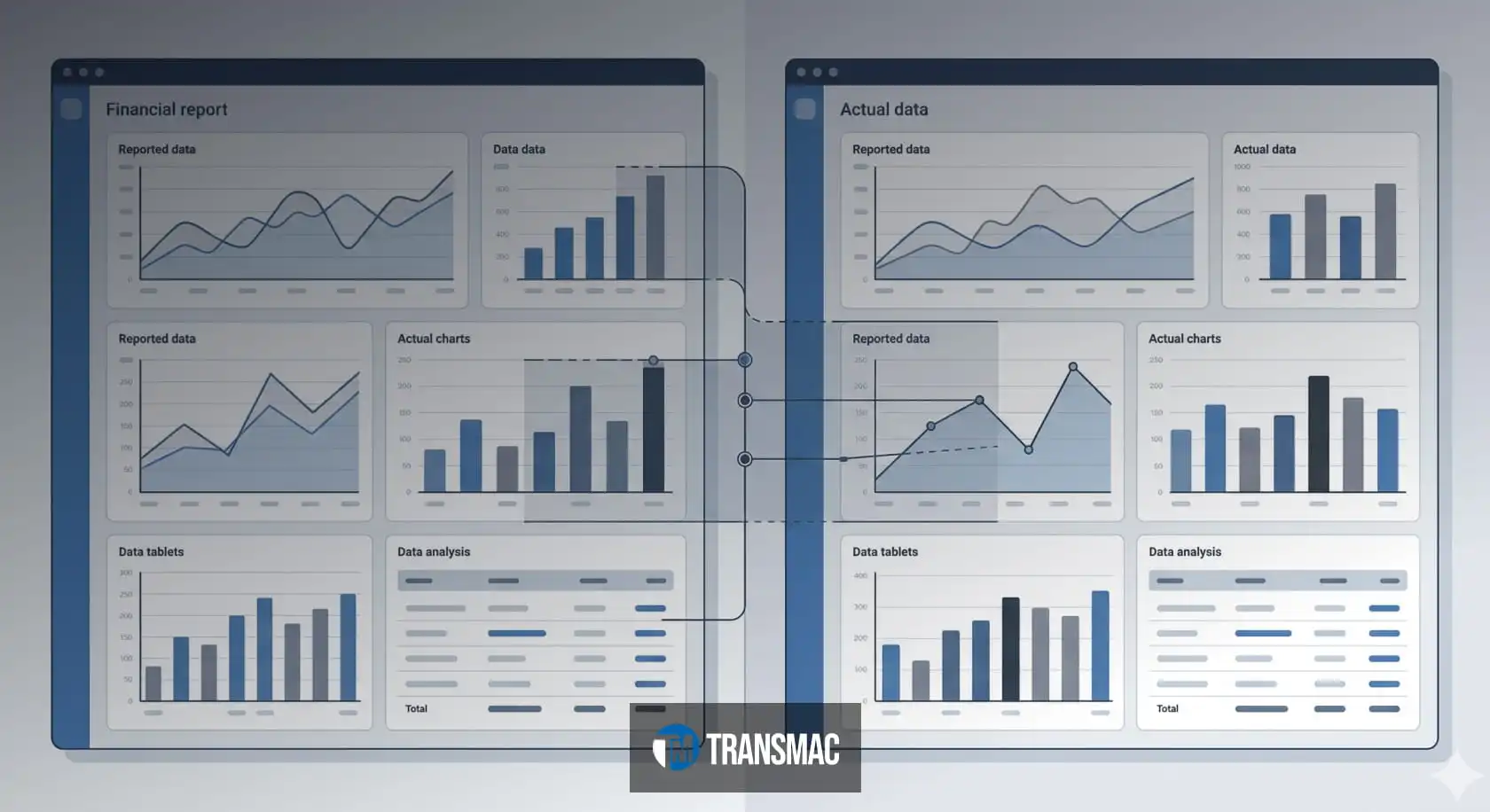
Financial reports become unreliable when data is inconsistent across workflows. Structured processes ensure accurate reporting and better decision-making.




We are ready to help you, save your time, and scale your business
Contact UsThere is a point in many businesses where the numbers stop making sense. Revenue looks different than expected. Expenses seem higher without a clear explanation. Cash flow does not reflect what is actually happening day to day. At first, it feels like a small mistake. Something that can be adjusted or corrected quickly.
But after a closer look, the issue usually goes deeper than a single error. The problem is not the report itself. It is the data behind it.
This is more common than most business owners expect. As operations grow, financial data becomes harder to keep consistent. Information comes from multiple sources, different people handle different parts of the process, and small delays start to affect the accuracy of everything that follows. What looks like a reporting issue is almost always a process issue.
Financial reports are not created independently. They are the result of everything that happens before them. Every invoice that is issued, every expense that is recorded, every transaction that is entered into the system contributes to the final numbers. If those inputs are incomplete, delayed, or inconsistent, the report cannot be accurate.
In practice, financial reporting depends on timing as much as it depends on accuracy. When transactions are recorded days or weeks after they occur, the data no longer represents the real state of the business. When invoices are missing or incorrectly categorized, reports begin to drift away from reality.
This is why many businesses feel that their reports are “technically correct” but still unreliable. The structure behind the data determines the quality of the output.
The mismatch between reports and real activity rarely starts at the reporting stage. It usually begins much earlier in the workflow. In many cases, transactions are recorded in batches rather than continuously. This creates gaps between what is happening in the business and what is reflected in the system. At the same time, invoices may be issued late or entered with incomplete information, which further distorts the data.
Another common issue is the use of multiple systems that are not fully aligned. Financial data might exist in accounting software, spreadsheets, and internal tools at the same time. Without a clear structure connecting them, inconsistencies become unavoidable.
Manual adjustments also play a role. When teams correct data without a consistent method or clear documentation, it becomes difficult to track what has changed and why. None of these issues seem critical on their own. But together, they create a situation where reports no longer reflect reality.
Financial workflows are rarely designed from the beginning. They are built gradually as the business grows. New tools are introduced to handle increasing complexity. New team members take ownership of specific tasks. Shortcuts are created to save time in the moment. Over time, these changes form a system that works, but not in a structured or predictable way.
This is where inconsistency becomes part of the process. There is no single source of truth. Data flows differently depending on who is handling it. Responsibilities are not always clearly defined. When one part of the process slows down or changes, everything else is affected. As the business grows, these issues become more visible. What was manageable at a smaller scale becomes difficult to control.
When financial reports do not match actual business activity, the impact goes beyond accounting. Decision-making becomes slower because numbers need to be verified before they can be used. Planning becomes more difficult because cash flow is not clearly understood. Teams spend more time checking data than acting on it.
Over time, this creates hesitation. Instead of relying on reports, businesses begin to question them. This leads to more manual checks, more adjustments, and more time spent trying to understand what should already be clear. The issue is not only accuracy. It is confidence. Without reliable data, even good decisions become harder to make.
When financial processes are structured properly, the difference is not dramatic at first, but it is consistent. Transactions are recorded as they happen rather than being delayed. Invoices are handled in a uniform way, which reduces variation in how data enters the system. Financial information becomes aligned across tools instead of being scattered.
As a result, reports begin to reflect real activity more closely. The need for manual corrections decreases. Reporting becomes faster because less time is spent fixing issues. The most important change is that the numbers start to make sense again. Instead of questioning the data, businesses can rely on it.
Automation is often seen as a solution to reporting problems, but its effectiveness depends on the structure of the process. It can help reduce manual work, synchronize data, and generate reports more quickly. However, it cannot fix inconsistencies in how data is collected and recorded.
If the input is incomplete or inaccurate, automation will simply produce faster results based on flawed data. This is why automation works best when it is applied to a well-defined workflow. In that environment, it supports consistency rather than replacing it.
For many businesses, the challenge is not understanding what needs to be done, but maintaining consistency in how it is done. This is where Transmac supports financial operations.
By focusing on structured bookkeeping, invoice processing, and data handling, Transmac helps ensure that financial data remains consistent from the beginning of the process. Instead of correcting issues at the reporting stage, the focus is on preventing them earlier.
This approach is particularly valuable for businesses operating across different markets, where variations in systems and requirements can make consistency more difficult to maintain. Over time, this leads to reporting that reflects actual business activity rather than approximations.