

VAT Return Belgium: Deadlines and Process | Transmac
Read More

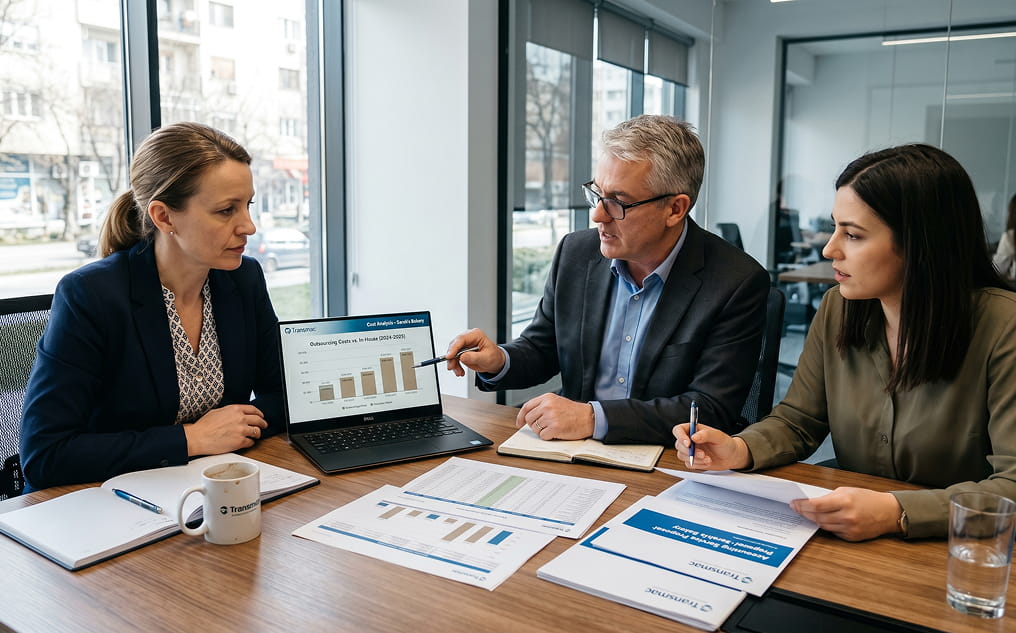
The cost of accounting outsourcing depends on how financial data is handled, how consistent it is, and how much time is spent maintaining it over time.




Supporting businesses across the UK, Belgium, and international markets




When looking into accounting outsourcing, cost is usually the first thing that comes up.
It’s a simple way to compare options. But accounting is not a one-time service. It’s an ongoing process that affects how financial data is handled every day.
Because of that, the difference in cost is not only in the price itself, but in how much time, correction, and effort is required to keep everything accurate over time.
The cost of accounting outsourcing is often reduced to a single number.
In practice, it includes everything required to keep financial data accurate, up to date, and usable without additional work.
If accounting requires constant checking, corrections, or follow-up, the effort around it increases, even if the initial price is lower.

The cost of accounting outsourcing depends on how your financial data is handled, how consistent the process is, and how much work is needed to keep everything accurate.

More transactions, payments, and financial records increase the amount of work required to keep everything accurate and up to date.

If financial data is already inconsistent or delayed, additional time is needed to review and structure it before it can be maintained properly.

When accounting is handled continuously, the effort remains stable. When it is handled in batches, more corrections and adjustments are required over time.

Multiple systems, currencies, or processes increase the complexity of managing financial data, which affects how accounting needs to be handled.
The cost of accounting outsourcing is not fixed. It changes based on how financial data is handled and how much effort is needed to keep it consistent.
Volume of financial activity
Condition of existing financial data
Number of systems and processes
Frequency of updates and reporting
Level of consistency required
Time spent reviewing financial data
Corrections due to delayed entries
Gaps between activity and reporting
Rework caused by inconsistencies
Additional effort to maintain accuracy
As operations grew, financial processes needed to stay consistent. This case study shows how Transmac keeps workflows structured and data aligned.
View Case Study


Articles based on day-to-day accounting processes, common issues businesses run into, and how they are handled in practice.
Get clarity on our services, processes, and benefits. We’ve collected the most frequent questions from our clients so you can quickly find the information you need.

Transmac provides outsourcing solutions in administrative support, bookkeeping, and accounting services. We help businesses reduce costs, stay compliant, and improve efficiency through accurate and timely data management.
Businesses usually consider outsourcing when transaction volume increases and internal processes become inconsistent. This often happens when financial data is delayed, reports require adjustments, or multiple systems are no longer aligned.
Yes, especially for small and growing businesses. As operations expand, maintaining consistent bookkeeping internally becomes more difficult, and outsourcing helps ensure that financial records remain accurate over time.
No, it supports existing teams rather than replacing them. Internal teams can focus on financial decisions, while the bookkeeping process is handled consistently in the background.
Accuracy improves through consistency. When transactions are recorded continuously and data is structured properly, there are fewer errors and less need for corrections during reporting.
Automation can handle repetitive tasks such as data entry and categorization, but it still depends on structured processes and validation. Without that, automated systems can still produce inaccurate results.